Isla Mujeres vs Cozumel: Which Island Fits Your Trip
Published Aug 31, 2026 · updated Aug 31, 2026
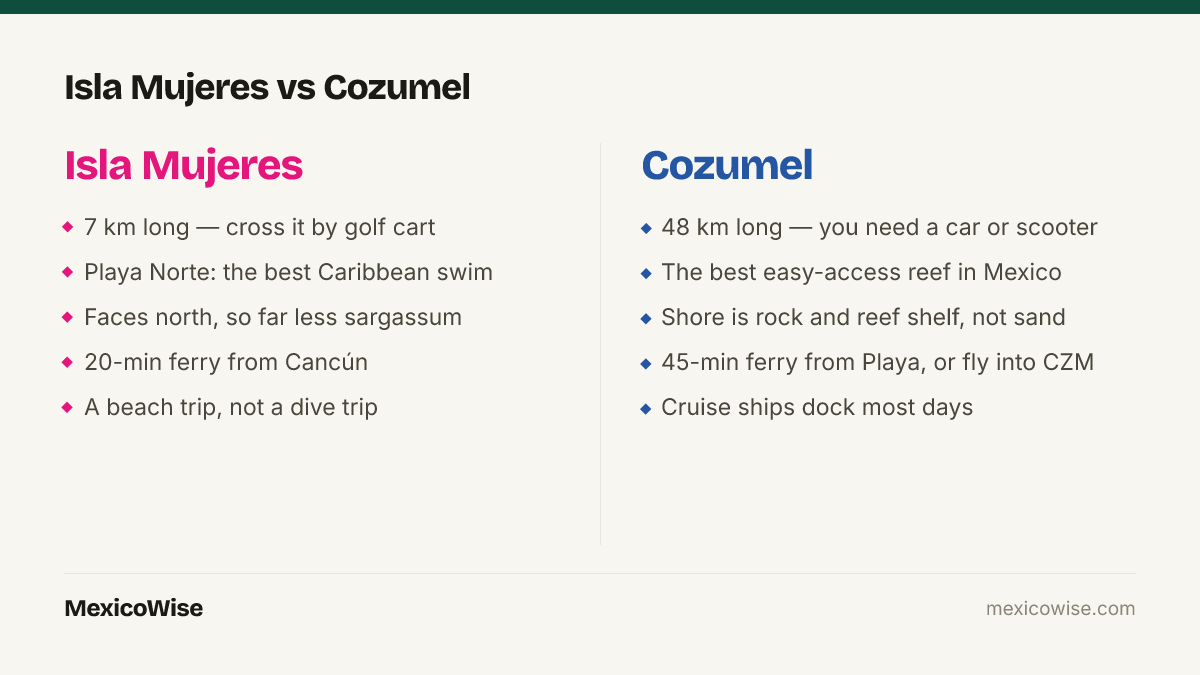
Isla Mujeres if you want to lie on the beach, Cozumel if you want to get under the water. That is the whole decision, and everything below is detail on it. Isla Mujeres is 7 km long, crossable by golf cart, and holds Playa Norte — the best swimming beach on the Mexican Caribbean. Cozumel is 48 km long, has its own airport, and fronts the Mesoamerican Reef with the best easy-access diving in the country.
Travelers keep treating them as interchangeable because both are islands off the same coast reachable by a short ferry. They are not remotely the same trip.
| Isla Mujeres | Cozumel | |
|---|---|---|
| Size | 7 km long, 650 m wide | 48 km long — the biggest island in Mexico |
| Getting there | Ultramar ferry from Cancún, 20 min | Ferry from Playa del Carmen, 45 min; or fly CZM |
| Getting around | Golf cart, or walk | Rental car or scooter — it is too big to walk |
| The beach | Playa Norte — wide, white, waist-deep | Mostly rock and reef shelf; a few sandy beach clubs |
| Under the water | Decent snorkel, MUSA underwater museum | The best reef in Mexico — Palancar, Colombia |
| Sargassum | Low — faces north | Low on the leeward west side |
| Cruise ships | Rare | Most days, often several |
| Nightlife | A handful of bars on Hidalgo | San Miguel has a real town’s worth |
| Value | High demand, small supply — pricey | Better value; a working island |
| Best for | Beach days, couples, families, easy trips | Divers, snorkelers, anyone with a licence |
Isla Mujeres: the beach, and not much else to think about
The case for Isla is uncomplicated. You take a 20-minute ferry from Puerto Juárez, you rent a golf cart, and within an hour of landing you are on a beach that genuinely looks like the brochure — Playa Norte is shallow, calm, and pale enough that the water reads turquoise even under cloud. Because it faces north rather than east, it escapes most of the sargassum that buries the mainland stretch from Puerto Morelos to Tulum between roughly April and October.
The island is small enough that you cannot really get it wrong. The north end holds the beach and most of the hotels, Hidalgo is the pedestrian strip with the restaurants and bars, and Punta Sur at the southern tip has the cliffs, the lighthouse and the sculpture garden. A golf cart does the whole loop in under an hour.
The honest limitations: it gets genuinely crowded from about 11am to 4pm when the day-trip ferries land, it is expensive for what the rooms actually are, and there is not a great deal to do beyond the water. If you need a programme, this is not your island.
Stay one night and you get the good version. By late afternoon the ferries have taken everyone back to Cancún and Playa Norte belongs to whoever stayed.
Cozumel: the reef is the point
Cozumel is a different proposition entirely — an island with a town, an airport, a highway around most of it, and a resident population who live there rather than serve it. San Miguel de Cozumel has actual streets, a real market, and restaurants that are not all facing the sea.
What brings people is the diving and snorkelling. The sheltered western side fronts the Mesoamerican Reef, and the wall dives at Palancar, Santa Rosa and Colombia are the reason Cozumel has the reputation it does. Visibility is routinely 30 metres or more, the current does most of the work as a drift dive, and shallow spots are reachable straight off beach clubs like Dzul-Ha and Money Bar with nothing but a snorkel.
The trade-off is the shoreline. Cozumel’s coast is largely ironshore — sharp fossilised reef rock — with sand mostly confined to beach clubs that charge entry. The windward east coast is dramatic and almost entirely unswimmable, with serious surf and no services for long stretches. It is a beautiful drive and a bad swim.
The other variable is cruise ships. Cozumel is one of the busiest cruise ports in the world, and on a three-ship day San Miguel’s waterfront and the nearer beach clubs fill up completely. Check a cruise schedule before you plan a downtown day; the dive sites themselves are unaffected because you are already out on a boat by 8am.
Getting between them, and whether to do both
They are not near each other. Isla Mujeres sits off Cancún at the north end of the coast; Cozumel is off Playa del Carmen, about 70 km south. There is no direct ferry. Doing both means ferry to the mainland, an hour of ADO bus or a taxi down the highway, then a second ferry — which is a travel day, not a transfer.
If you have a week on this coast, both is entirely reasonable: three nights on Cozumel diving, two on Isla doing nothing, and the transfer day in between. If you have four days, pick one.
What a friend who lives here would tell you
Do not book Cozumel if nobody in your party is going in the water past their knees. It is the most common mistake people make on this coast — they read that Cozumel is the famous island, arrive expecting Playa Norte, and find rock. The island rewards a specific interest, intensely.
And do not book Isla Mujeres for a week unless lying still is genuinely the plan. Three nights is the sweet spot. After that, people start taking the ferry back just to have something to do, which is a strange way to spend a Caribbean holiday.
If you want the reef and the sand, the honest answer is neither of these as a single base: stay in Playa del Carmen, day-trip to Cozumel for the diving, and take a separate day up to Isla. Compare that in Cancún vs Playa del Carmen vs Tulum.
The verdict
- A beach holiday, minimum planning: Isla Mujeres, three nights.
- Diving or serious snorkelling: Cozumel, and get on a morning boat.
- Families with small children: Isla Mujeres — Playa Norte is waist-deep for a long way.
- You have a week and want both: Cozumel first, Isla last, and treat the middle day as travel.
- Cheapest good version: Cozumel, on the leeward side, avoiding cruise days.
More from Quintana Roo